
00:00:00.001 –> 00:00:06.560
コスプレの素材と技術について ポイントをサクッと×サクッと(さくっと)
Meaning:
Quickly and efficiently; without taking much time.
Grammar:
- An adverb, often classified as onomatopoeia or mimetic word.
Usage:
Used colloquially to describe an action that is done swiftly and crisply, without fuss. It implies both speed and ease.
Examples:
この仕事はサクッと終わらせましょう。
Let's get this work done quickly.
今日のランチはサクッと食べられるものがいいな。
For lunch today, I'd like something I can eat quickly.
Register/Formality: Casual解説しますね
00:00:06.560 –> 00:00:13.880
えーと今回の元ネタ×元ネタ(もとねた)
Meaning:
Source material; the original work something is based on.
Grammar:
- A compound noun from 元 (moto - origin) and ネタ (neta - topic, material).
Usage:
Commonly used in fan culture (anime, manga, games) to refer to the original story, character, or concept that a derivative work like cosplay, fan-art, or a parody is based on.
Examples:
この映画の元ネタは有名な漫画です。
The source material for this movie is a famous manga.
元ネタを知らないと、このジョークは分からないかもしれない。
If you don't know the source material, you might not get this joke.
Register/Formality: Informal/Casualは「コスプレの素材と技術 製作者×製作者(せいさくしゃ)
Meaning:
Creator; maker; producer.
Grammar:
- A noun composed of 制作 (seisaku - production/creation) and 者 (sha - person).
Usage:
A general term for the person who creates something, such as a costume, a piece of art, a film, or software.
Examples:
この素晴らしい衣装の製作者に会ってみたいです。
I'd like to meet the creator of this amazing costume.
彼は有名なゲームの製作者です。
He is a famous game producer.
Register/Formality: Neutralの武器庫×武器庫(ぶきこ)
Meaning:
Armory; arsenal.
Grammar:
- A noun composed of 武器 (buki - weapon) and 庫 (ko - storehouse).
Usage:
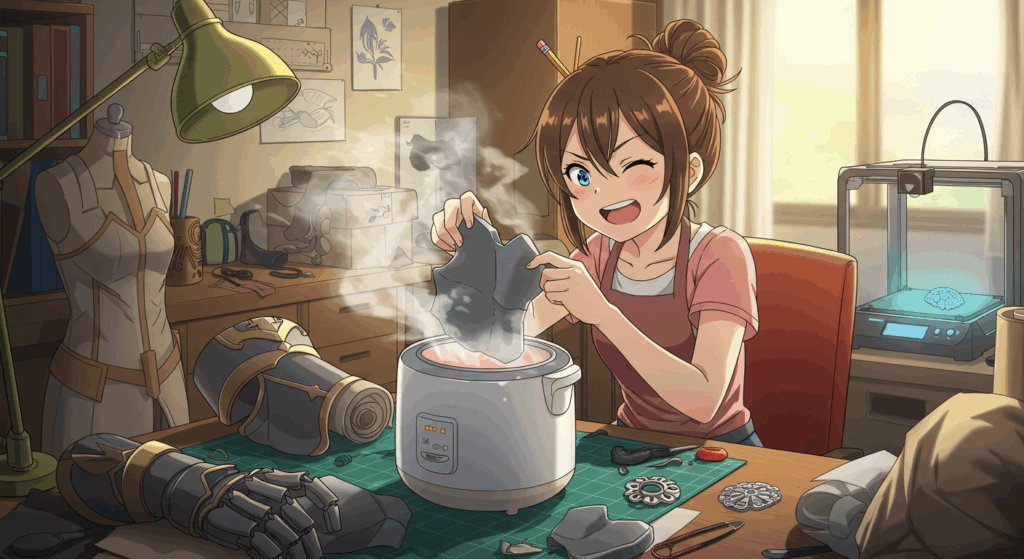
Literally a place where weapons are stored. In this context, it's used metaphorically to describe a cosplayer's extensive collection of tools and materials, treating them as the 'weapons' of their craft.
Examples:
昔の城には大きな武器庫があった。
Old castles had large armories.
彼の知識は、議論における彼の武器庫だ。
His knowledge is his arsenal in debates.
Register/Formality: Neutral」っていう資料でして
00:00:13.880 –> 00:00:22.440
コスプレイヤーさんがキャラクターをリアルに作り上げる×作り上げる(つくりあげる)
Meaning:
To build up; to complete; to create something with effort.
Grammar:
- A compound verb from 作る (tsukuru - to make) and 上げる (ageru - to raise up/to complete).
Usage:
This verb implies a process of carefully building something to completion. It carries a stronger nuance of effort and finishing a project than the simpler verb 作る (tsukuru).
Examples:
彼女は三ヶ月かけて、そのドレスを作り上げた。
She spent three months completing that dress.
チーム全員でこの計画を作り上げました。
The entire team built this plan together.
Register/Formality: Neutralために
どんな素材とかテクニックを使ってるのかなっていうそういう話です
00:00:22.440 –> 00:00:33.840
まずやっぱり基本は×やっぱり基本は(やっぱりきほんは)
Meaning:
As expected, the basis is...; After all, the fundamental thing is...
Grammar:
- やっぱり (yappari): Adverb meaning 'as expected', 'after all'. A colloquial form of やはり (yahari).
- 基本 (kihon): Noun meaning 'foundation', 'basis'.
- は (wa): Topic marker particle.
Structure: The phrase 'やっぱり X は Y' is a common pattern to state what the speaker believes is a fundamental or obvious truth.
Usage:
Used to emphasize a core concept or foundation that, in the speaker's view, is undeniable or should be commonly understood.
Examples:
色々なお菓子があるけど、やっぱり基本はチョコレートだ。
There are many kinds of sweets, but after all, the foundation is chocolate.
どんな言語でも、やっぱり基本は単語を覚えることです。
In any language, as you'd expect, the basic thing is to memorize vocabulary.
Register/Formality: Casual/Conversational布 コスチュームの土台×土台(どだい)
Meaning:
Foundation; base; groundwork.
Grammar:
- A noun.
Usage:
Can be used literally for the foundation of a building or, as in this case, metaphorically for the base structure of something like a costume, an argument, or a skill.
Examples:
まず、スカートの土台を作りましょう。
First, let's make the base of the skirt.
彼の成功の土台には、長年の努力があった。
The foundation of his success was years of hard work.
Register/Formality: Neutralになりますよね
腕×綿(わた)
Meaning:
Cotton.
Grammar:
- A noun.
Usage:
A common natural fiber used for making clothes, including cosplay costumes.
Examples:
このシャツは綿100パーセントです。
This shirt is 100% cotton.
綿は肌触りが良い素材です。
Cotton is a material that feels nice against the skin.
Common Mistakes:
The original text uses the kanji 腕 (ude - arm), which is very likely a typo for 綿 (wata - cotton) in this context of cosplay materials. The characters look somewhat similar. 'Cotton' fits the context of 'natural materials' perfectly. とか皮×革(かわ)
Meaning:
Leather.
Grammar:
- A noun.
Usage:
Refers to processed animal hide used for making items like jackets, boots, belts, and armor pieces in cosplay.
Examples:
彼は革のジャケットを着ていた。
He was wearing a leather jacket.
このブーツは本物の革でできている。
These boots are made of real leather.
Nuance:
The kanji 皮 (kawa) used in the text can mean 'skin' or 'hide', while 革 (kawa) specifically means 'leather' (processed hide). In this context, both refer to leather as a material. 革 is the more precise term. みたいな天然素材×天然素材(てんねんそざい)
Meaning:
Natural materials.
Grammar:
- A noun phrase composed of 天然 (tennen - natural) and 素材 (sozai - material).
Usage:
Refers to materials derived from natural sources, like plants (cotton, linen) or animals (wool, leather), as opposed to synthetic, man-made materials.
Examples:
彼女は化学繊維よりも天然素材の服を好みます。
She prefers clothes made of natural materials over synthetic fibers.
この家具は天然素材だけで作られている。
This furniture is made only from natural materials.
Register/Formality: Neutralもあればポリエステルやあの伸びる×伸びる(のびる)
Meaning:
To stretch; to extend.
Grammar:
- An intransitive u-verb. In the phrase '伸びるスパンデックス', it acts as a relative clause modifying 'spandex'.
Usage:
Describes the property of a material being elastic or stretchy. It can also be used for things that grow, like hair or height.
Examples:
この生地はとてもよく伸びる。
This fabric stretches very well.
彼は背が伸びた。
He grew taller.
Register/Formality: Neutralスパンデックスみたいな
00:00:33.840 –> 00:00:40.320
合成繊維×合成繊維(ごうせいせんい)
Meaning:
Synthetic fibers.
Grammar:
- A noun phrase from 合成 (gōsei - synthesis) and 繊維 (sen'i - fiber).
Usage:
The opposite of 'natural materials' (天然素材). It refers to man-made fibers like polyester, nylon, acrylic, and spandex.
Examples:
多くのスポーツウェアは速乾性のある合成繊維で作られています。
Many sportswear items are made from quick-drying synthetic fibers.
合成繊維は天然素材より安いことが多い。
Synthetic fibers are often cheaper than natural materials.
Register/Formality: Neutralもあって 作りたいキャラクターとか表現に合わせて選んでいく感じです
00:00:40.320 –> 00:00:49.920
ほんと選択肢×選択肢(せんたくし)
Meaning:
Options; choices.
Grammar:
- A noun composed of 選択 (sentaku - selection/choice) and 肢 (shi - choice/branch).
Usage:
Refers to the range of available alternatives or possibilities one can choose from.
Examples:
私たちには三つの選択肢があります。
We have three options.
選択肢が多すぎて、どれにすればいいか決められない。
There are too many choices, so I can't decide which one to go with.
Register/Formality: Neutral多いんですよ 次に鎧とかちょっとした小道具×小道具(こどうぐ)
Meaning:
Props; small tools.
Grammar:
- A noun from 小 (ko - small) and 道具 (dōgu - tool/implement).
Usage:
In the context of theater or cosplay, it refers to items carried or used by a character, such as a weapon, a magic wand, or a book. It distinguishes these from the main costume or the set.
Examples:
彼はコスプレの小道具を全部自分で作りました。
He made all of his cosplay props himself.
このキャラクターは剣や盾などの小道具が必要です。
This character needs props like a sword and shield.
Register/Formality: Neutral作り
ここで大活躍する×大活躍する(だいかつやくする)
Meaning:
To play a very active part; to be extremely useful; to be outstanding.
Grammar:
- A suru-verb from the noun 大活躍 (daikatsuyaku - great success/activity).
Usage:
Used to describe a person or thing that performs exceptionally well or is highly effective in a particular situation. It has a very positive connotation.
Examples:
新しいソフトウェアが仕事で大活躍している。
The new software is proving extremely useful at work.
その選手は試合で大活躍した。
That player was outstanding in the match.
Register/Formality: Neutralのが知ってる人も多いかな
00:00:49.920 –> 00:00:57.360
EVAフォームですね これ軽くて加工しやすい×加工しやすい(かこうしやすい)
Meaning:
Easy to process; easy to work with.
Grammar:
- A compound i-adjective. It's formed from the stem of the verb 加工する (kakō suru - to process) and the suffix やすい (-yasui - easy to do).
Usage:
Describes a material that can be easily cut, shaped, sanded, or otherwise modified.
Examples:
木材は金属よりも加工しやすいです。
Wood is easier to work with than metal.
この粘土は柔らかくて加工しやすい。
This clay is soft and easy to work with.
Register/Formality: Neutralし熱を加える×熱を加える(ねつをくわえる)
Meaning:
To apply heat.
Grammar:
- A verb phrase consisting of the noun 熱 (netsu - heat), the object particle を (o), and the verb 加える (kuwaeru - to add).
Usage:
A standard expression for the action of heating something, commonly used in crafting, cooking, and science.
Examples:
金属に熱を加えると、柔らかくなります。
When you apply heat to metal, it becomes soft.
水に熱を加え続けると、沸騰します。
If you keep applying heat to water, it boils.
Register/Formality: Neutralと形も自由に変えられるんで
00:00:57.360 –> 00:01:03.920
もう今のコスプレには欠かせない主力素材×欠かせない主力素材(かかせないしゅりょくそざい)
Meaning:
An indispensable primary material.
Grammar:
- A noun phrase.
- 欠かせない (kakasenai): An adjective meaning 'indispensable' or 'essential'.
- 主力 (shuryoku): A noun meaning 'main force' or 'primary'.
- 素材 (sozai): A noun meaning 'material'.
Usage:
This phrase describes a core component that is both essential and central to a field or project. EVA foam is described as such for modern cosplay.
Examples:
米は日本食に欠かせない主力食材です。
Rice is an indispensable primary ingredient in Japanese cuisine.
彼はチームの欠かせない主力選手です。
He is an essential star player for the team.
Register/Formality: Neutralって感じです 金属×金属(きんぞく)
Meaning:
Metal.
Grammar:
- A noun.
Usage:
A general term for any metallic element or alloy, such as iron, aluminum, gold, or steel.
Examples:
このスプーンは金属でできています。
This spoon is made of metal.
彼は金属アレルギーがあるので、アクセサリーをつけられない。
He has a metal allergy, so he can't wear accessories.
Register/Formality: Neutralみたいにも皮みたいにも見せられちゃう
00:01:03.920 –> 00:01:12.680
あとはワーブラみたいな熱でぐにゃっと曲げられる×ぐにゃっと曲げられる(ぐにゃっとまげられる)
Meaning:
Can be bent limply or flexibly.
Grammar:
- A phrase combining an adverb and a potential verb.
- ぐにゃっと (gunyatto): An onomatopoeic/mimetic adverb describing something becoming soft, limp, or losing its rigid shape.
- 曲げられる (magerareru): The potential form of 曲げる (mageru - to bend), meaning 'can bend'.
Usage:
Emphasizes that something can be bent easily and flexibly, without snapping. The word 'gunyatto' adds a vivid, informal image of the material becoming soft and pliable.
Examples:
この針金は手でぐにゃっと曲げられる。
This wire can be bent limply by hand.
暑さでプラスチックの定規がぐにゃっと曲がってしまった。
The plastic ruler got bent out of shape in the heat.
Register/Formality: Casual/Conversationalプラスチック
これもね丈夫さがいる×丈夫さがいる(じょうぶさがいる)
Meaning:
To require durability; to need to be sturdy.
Grammar:
- A phrase.
- 丈夫さ (jōbu-sa): Noun for 'sturdiness', from the na-adjective 丈夫 (jōbu) + the nominalizing suffix さ (-sa).
- が (ga): Subject particle.
- いる (iru): The verb 'to need' or 'to require' (written with hiragana for this meaning).
Usage:
A common pattern (Noun + が + いる) to express that something is necessary. Here, it means that the parts being made need to have the quality of being durable.
Examples:
登山用のバッグには丈夫さがいる。
Durability is required for a hiking backpack.
この仕事には忍耐強さがいる。
This job requires patience.
Register/Formality: Neutral細かいパーツ作りにすごく便利です
00:01:12.680 –> 00:01:22.860
最後に接着剤×接着剤(せっちゃくざい)
Meaning:
Adhesive; glue.
Grammar:
- A noun composed of 接着 (setchaku - adhesion) and 剤 (zai - agent/chemical).
Usage:
A general term for any substance used for bonding or sticking objects together, such as super glue, wood glue, or hot glue.
Examples:
壊れたカップを接着剤で直した。
I fixed the broken cup with glue.
この接着剤が乾くまで、少し時間がかかります。
It takes a little time for this adhesive to dry.
Register/Formality: Neutralとまあ現代ならではの技術
パーツをくっつける×くっつける(くっつける)
Meaning:
To stick together; to attach.
Grammar:
- A transitive ru-verb.
Usage:
A common, everyday word for attaching one thing to another. It's slightly more informal than 接着する (setchaku suru). It can be used for actions involving glue, tape, magnets, or simply placing things close together.
Examples:
二枚の紙をのりでくっつけた。
I stuck the two pieces of paper together with glue.
冷蔵庫にマグネットをくっつける。
I'll stick a magnet on the fridge.
Register/Formality: Neutral/Slightly Informal接着剤もあのコンタクトセメントとかホットグルーとか色々あって
00:01:22.860 –> 00:01:30.160
ちゃんと×ちゃんと(ちゃんと)
Meaning:
Properly; correctly; reliably; neatly.
Grammar:
- An adverb.
Usage:
A very common and important word in Japanese. It implies doing something the right way, completely, and without cutting corners. It carries a nuance of diligence and responsibility.
Examples:
出かける前に、ドアの鍵をちゃんと閉めてください。
Please lock the door properly before you go out.
彼はちゃんと約束を守る人だ。
He is a person who reliably keeps his promises.
Cultural Context:
The concept of 'chanto' is highly valued in Japanese culture, reflecting an emphasis on doing things thoroughly and conscientiously. It's more than just 'correctly'; it's about doing something with the right attitude. 素材に合わせて使い分けるのが大事で技術面で言うと×技術面で言うと(ぎじゅつめんでいうと)
Meaning:
In terms of technology; from a technical standpoint.
Grammar:
- A set phrase.
- 技術 (gijutsu - technology/skill) + 面 (men - side/aspect) + で言うと (de iu to - speaking of).
Structure: The pattern '(Noun)面で言うと' means 'speaking from the aspect of (Noun)'.
Usage:
Used to introduce a comment or shift the topic to a specific perspective, in this case, the technical aspect of cosplay creation.
Examples:
コスト面で言うと、こちらの方が安いです。
In terms of cost, this one is cheaper.
デザイン面で言うと、A案のほうが好きです。
From a design standpoint, I prefer Plan A.
Register/Formality: Neutral特にすごいのが3Dプリンター
00:01:30.160 –> 00:01:35.800
これがあると複雑な形のアクセサリーとかもかなり精密に×かなり精密に(かなりせいみつに)
Meaning:
Quite precisely; very accurately.
Grammar:
- An adverbial phrase.
- かなり (kanari): Adverb meaning 'quite', 'considerably', 'fairly'.
- 精密に (seimitsu ni): Adverbial form of the na-adjective 精密 (seimitsu - precise, accurate).
Usage:
Used to emphasize that an action is performed with a high degree of precision, detail, and accuracy.
Examples:
この機械はかなり精密に部品を組み立てることができる。
This machine can assemble parts quite precisely.
計画はかなり精密に立てる必要があります。
The plan needs to be made very accurately.
Register/Formality: Neutral作れちゃうんですよね
00:01:35.800 –> 00:01:42.230
もちろんeva フォームを温めて曲げる×温めて曲げる(あたためてまげる)
Meaning:
To heat and bend.
Grammar:
- Two verbs connected by the te-form, indicating sequence.
- 温めて (atatamete): The te-form of 温める (atatameru - to heat up).
- 曲げる (mageru): The dictionary form of the verb 'to bend'.
Usage:
Describes a two-step process: first, you heat something, and then you bend it. The te-form is a common way to link sequential actions.
Examples:
鉄は赤くなるまで温めて曲げる。
You heat iron until it's red hot and then bend it.
アクリル板を温めて曲げることで、カーブを作れます。
You can create a curve by heating and bending an acrylic plate.
Register/Formality: Neutralヒートガンとかそういう道具もも必須アイテム×必須アイテム(ひっすアイテム)
Meaning:
Essential item; must-have item.
Grammar:
- A noun phrase combining the Japanese word 必須 (hissu - essential, required) and the loanword アイテム (aitemu - item).
Usage:
A common, modern-sounding phrase to describe something that is absolutely necessary for a particular purpose or lifestyle.
Examples:
スマートフォンは現代生活の必須アイテムです。
Smartphones are an essential item for modern life.
旅行には、この翻訳アプリが必須アイテムだよ。
For traveling, this translation app is a must-have item.
Register/Formality: Neutral/Slightly Casualです
00:01:42.230 –> 00:01:47.880
つまりコスプレ制作って昔ながらの裁縫技術×昔ながらの裁縫技術(むかしながらのさいほうぎじゅつ)
Meaning:
Traditional sewing techniques.
Grammar:
- A noun phrase.
- 昔ながら (mukashi nagara): An expression meaning 'traditional', 'old-fashioned', 'as it was in the old days'.
- の (no): Possessive particle.
- 裁縫 (saihou): Noun for 'sewing'.
- 技術 (gijutsu): Noun for 'technique' or 'skill'.
Usage:
Refers to sewing and tailoring skills that have been passed down through time, often done by hand, as opposed to modern, machine-heavy methods.
Examples:
この着物は昔ながらの裁縫技術で作られています。
This kimono is made with traditional sewing techniques.
彼女は祖母から昔ながらの料理を学んだ。
She learned traditional cooking from her grandmother.
Register/Formality: Neutralから最新の3 d プリントまで
00:01:47.880 –> 00:01:54.880
ほんといろんな素材と道具をフル活用する クリエイティブな挑戦×挑戦(ちょうせん)
Meaning:
A challenge; an attempt.
Grammar:
- A noun. It can be combined with する (suru) to form the verb 挑戦する (chōsen suru - to challenge, to attempt).
Usage:
Refers to the act of trying to do something difficult or ambitious. It generally has a positive connotation of taking on a worthy goal, rather than a negative one of facing an obstacle.
Examples:
新しい言語を学ぶことは、良い挑戦です。
Learning a new language is a good challenge.
彼は世界記録に挑戦した。
He attempted to break the world record.
Register/Formality: Neutralなんですね