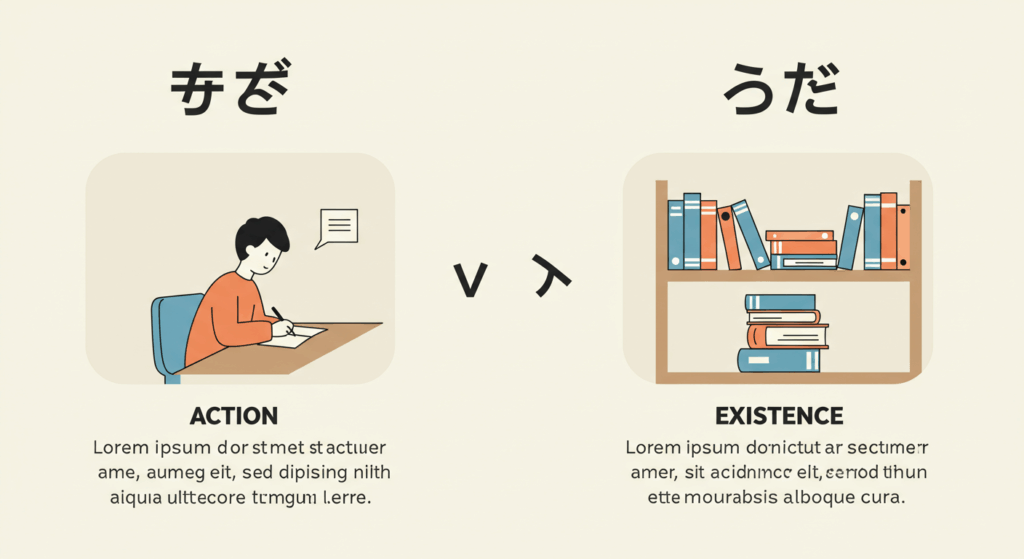

Today, let’s look together at the difference between the particles では (dewa) and には (niwa), a common point of confusion for many JLPT N2 learners.
Step 1: Connect to Universal Experiences
Imagine you’re working at a Japanese company. Your boss asks you, “Please book a conference room.” You successfully book one and now you need to report back to your boss.
- Report A: 「会議室ではミーティングができます。」 (Kaigishitsu dewa mītingu ga dekimasu.)
- Report B: 「会議室には誰もいません。」 (Kaigishitsu niwa daremo imasen.)
Both are correct sentences, but their nuance is completely different. This difference is the core of では and には. First, let’s remember that these particles are combinations of で + は and に + は. This means that if you understand the basic roles of で and に, your understanding will deepen instantly.
Step 2: Build the Bridge
Let’s grasp the fundamental image of では and には.
で→ The Location of an Action- It indicates the place where an action happens. Think of it as dynamic, like in “I play soccer at the park” (公園でサッカーをする) or “I meet a friend at the station” (駅で友達と会う).
では(dewa) emphasizes that location of action. It carries the nuance, “Not somewhere else, but here, an action takes place.”
に→ The Location/Time of Existence- It indicates the place where something exists or a specific point in time. Think of it as static, like in “There is a cat in the room” (部屋に猫がいる), “There is a book on the desk” (机の上に本がある), or “I wake up at 3 o’clock” (3時に起きる).
には(niwa) emphasizes that location or time of existence. It carries the nuance, “Not in another place/at another time, but here/at this time, something exists.”
Step 3: Deepen Understanding Through Examples
Let’s look at how to use them in specific scenarios.
Scenario 1: Talking About a Place
A friend asks you, “Where are you going to study this weekend?”
- Example A: 「図書館では、静かに勉強できますよ。」
- Rōmaji: Toshokan dewa, shizuka ni benkyō dekimasu yo.
- Natural English: “At the library, you can study quietly.”
- Explanation: The key point here is the action of “studying.” It emphasizes the library as a place for studying, carrying a nuance of contrast: “Unlike other places like a café or my house, at the library, you can concentrate.”
- Example B: 「図書館には、専門書がたくさんありますよ。」
- Rōmaji: Toshokan niwa, senmonsho ga takusan arimasu yo.
- Natural English: “In the library, there are a lot of specialized books.”
- Explanation: The key point here is the existence of “specialized books.” It emphasizes the location of their existence, with the nuance: “They might not be in other places, but in the library, they have them.”
Scenario 2: Talking About Goals or Objectives
You are giving advice to a junior colleague about achieving a work goal.
- Example C: 「このプロジェクトを成功させるには、チームワークが不可欠だ。」
- Rōmaji: Kono purojekuto o seikō saseru niwa, chīmuwāku ga fukaketsu da.
- Natural English: “To make this project succeed, teamwork is essential.”
- Explanation: In the pattern
〜するには(~suru niwa), this is used to state a necessary condition to achieve a goal. It emphasizes that specific condition: “In order to achieve this goal (and not some other way), this is what’s necessary.”
- Example D: 「この方法では、目標達成は難しいかもしれない。」
- Rōmaji: Kono hōhō dewa, mokuhyō tassei wa muzukashii kamoshirenai.
- Natural English: “With this method, achieving the goal might be difficult.”
- Explanation: In the pattern
〜では(~dewa), this is used to state an evaluation of a means or method. It limits the scope to that method and gives a (usually negative) evaluation: “With this method (though it might be possible with another one), it won’t work well.”
Step 4: Interactive Engagement
Now, let’s think of situations around you where you could use では and には.
Question 1: Imagine you are introducing your city to someone. Keeping “action” (what you can do) and “existence” (what is there) in mind, try to make a sentence using では and one using には.
- Example: 「私の街では、毎年夏に大きなお祭りがあります。」(In my town, a big festival is held every summer.) → Festival is held = action
- Example: 「私の街には、景色のいい公園があります。」(In my town, there is a park with a nice view.) → Park exists = existence
Question 2: Regarding the goal “to become good at Japanese,” use the 〜するには pattern to explain what you think is necessary.
- Example: 「日本語が上手になるには、毎日少しでも話す機会を作ることが大切だと思います。」( To become good at Japanese, I think it’s important to create opportunities to speak, even a little, every day.)
Step 5: Reinforce Understanding
Let’s return to the first scenario.
- 「会議室ではミーティングができます。」 (At the conference room, you can have a meeting.)
- This emphasizes the location of the action “to have a meeting.” It conveys, “It’s possible to perform this action in the conference room (as opposed to other rooms).”
- 「会議室には誰もいません。」 (In the conference room, there is no one.)
- This emphasizes the state of existence “no one is there.” It conveys, “I don’t know about other rooms, but at least in this conference room, there is no one.”
In this way, では acts like a spotlight on the stage for an action, while には acts like a spotlight that pinpoints the location/time of existence or a specific objective.
From now on, try to be conscious of whether the verb in a sentence describes an “action” or “existence.” Just doing that will make distinguishing between では and には much easier. Please try to use them consciously in your daily conversations and emails